Health and Medical Sites Rely on Google for 87% of Their Traffic in 2026

By Perry Stevens, Blend Local Search Marketing | May 2026
Key Stat: 87% of health and medical website traffic comes from Google — more than any other industry. Travel is second at 73%, personal finance at 68%. For orthodontists specifically, social media contributes less than 2-3% of total traffic. Google's "Your Money or Your Life" (YMYL) standards mean medical sites must demonstrate E-E-A-T (Experience, Expertise, Authoritativeness, Trustworthiness) to rank. (Source: GrowthBadger, "Traffic Study", 2024; Google Search Quality Rater Guidelines, 2025)
TL;DR
- 87% of medical website traffic comes from Google — no other channel comes close.
- Social media contributes only 2-3% for orthodontists — it's a branding tool, not a lead generator.
- E-E-A-T is critical for medical sites — Google holds YMYL content to the highest standards.
- Constant content creation, mobile optimisation, and local targeting are the three pillars of medical SEO.
- For specialist orthodontic marketing, contact Blend Local Search Marketing.
How Health and Medical Websites Rely on Google
The nature of the topic of health makes Google a very valuable tool for medical professionals running their own health and medical sites. Prospective patients turn to the largest search engine in the world to find more information about their health issues or cosmetic procedures they would like to undertake.
Understanding how Google ranks your practice's website and what places a health-related website above the competition is essential to placing your services in front of your target audience so that they may come in contact with you.
How Do Medical Sites Compare to Those of Other Industries?
With over 90 percent of searches occurring on Google, it is understandable that striving to be compliant with the search engine's criteria can be essential to the viability of a website in any niche. The health and medical field has been shown to be the most reliant on Google's traffic, with 87 percent of visitors to the medical websites coming from the search giant. Travel is ranked second with almost 73 percent of traffic coming from Google while the personal finance field gets almost 68 percent of its visitors from the top search engine.
Read the full Traffic Study here that covers the health and medical sites niche in-depth.
What Does This Mean for my Orthodontic Practice?
Google is constantly innovating and changing the ecosystem of services they offer. Staying up-to-date with the tech giant's ever-evolving algorithms and requirements is important for achieving maximum exposure. It used to be that you could gain the top spot in the search results for your desired keywords and your website could remain there without much effort. This is not the case anymore as your website needs to offer helpful content uploaded regularly in order to stay relevant in Google's eyes.
What Are Other Main Traffic Sources to Consider?
There are other sources that an orthodontic practice can use in order to attract clients. None of these other sources can bring a windfall of traffic quite like Google, but a few are growing in importance to medical field websites and may be worth devoting a little effort for the promise they hold for the future.
From our extensive experience in the field of orthodontic marketing, our results show that social media contributes less than 2 to 3 percent of traffic to orthodontists' websites. Facebook gets the lion's share of this but as you can imagine, it pale's in comparison to the organic traffic from Google.
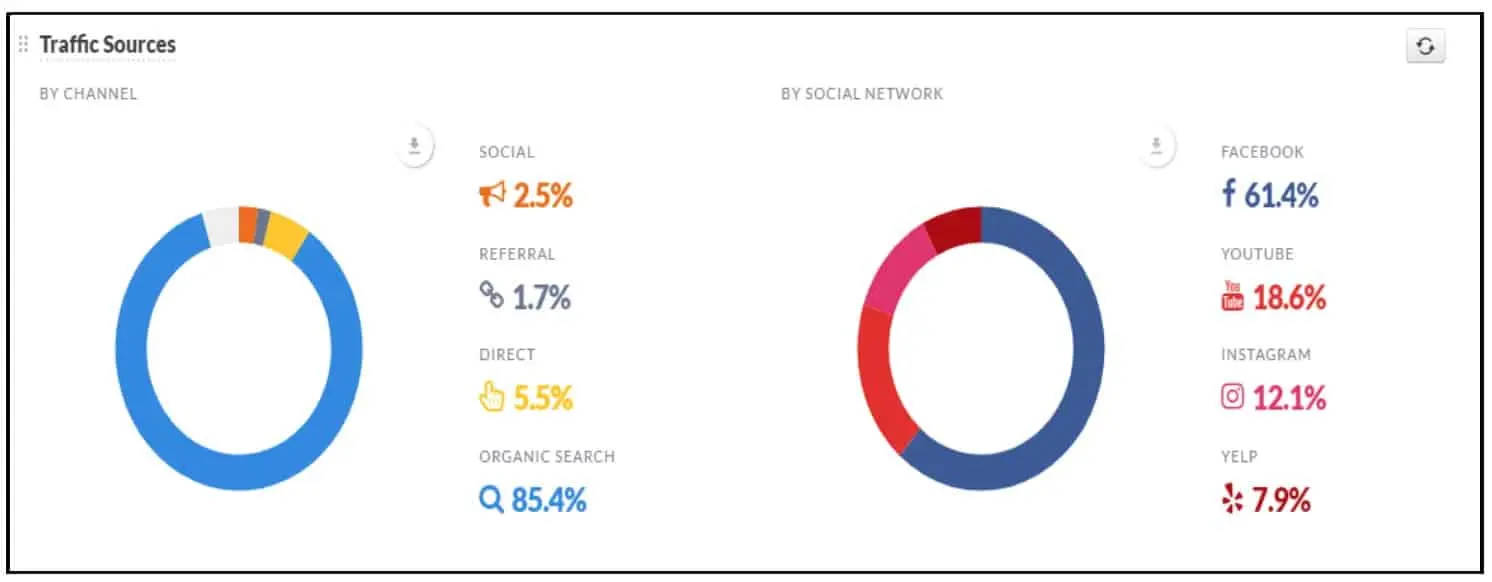
Instagram is increasing in importance for branding practices in the medical field, especially those that offer cosmetic services. The visual nature of the platform, as well as the demographics and the attitude of its users, make it a potentially effective way to promote aesthetic procedures.
Orthodontics is a specialty that could benefit from an Instagram presence. A simple search will reveal over one million posts on Instagram under the orthodontics hashtag.
The downside of using Instagram to reach new customers is the limited availability to add links in your posts, so potential customers view and scroll rather than click or call.
Should You Spend Time and Money on Social Media?
Social media has its place for a company's long-term branding but as a lead-generation tool, we have found that it is not as worthwhile an option as focusing on Google and this new study of 3.25 Billion sites collaborates our data.
Most orthodontists devote a disproportionate amount of time and money to promoting their business on social media. A simple juxtaposition of conversions achieved from organic Google traffic and even paid Google ads as compared to social media efforts will show you that time spent on SEO (Search Engine Optimization), content creation and review acquisition yields a higher return on investment.
Our own research and results prompted us to discontinue offering social media marketing services to our clientele of orthodontists. By devoting our efforts to achieving results on Google, our loyal clients see increased results and conversions.
How Were Health and Medical Websites Affected by Google's Recent Changes?
Recently, Google implemented its Broad Core updates which affected many websites from other industries but seemingly had only a small bearing on the health sector. What you need to know with regards to your own practice's website is that it needs to project a sense of E-A-T (Expertise, Authoritativeness, Trustworthiness). Keeping your site up-to-date with the latest trends in the orthodontics field and providing fresh and helpful content should be good enough to keep your online presence unaffected by changes that Google implements to its ranking criteria and core updates.
What You Can Do to Boost Your Orthodontic Practice's Website?
Understanding your audience's mindset and behavior is critical to offering a user experience that is tailored to their needs. Google rewards websites that it deems provide seamless functionality and relevant content to a niche. You need to attract internet users that are looking for your services and give them the exact information they need in order to solve their problem.
Constant Content Creation
By maintaining a blog on health and medical sites with regular posts that address the issues that concern prospective orthodontics patients, you will attract visitors that have specific needs. For example, by posting an article on braces for adults, you will attract a specific type of user that is actively looking for this service.
Many orthodontists or the agencies they employ will just mention that they offer braces among their services and leave it at that. With content creation, your targeting options are virtually limitless. You can climb to the top of Google's rankings for different keywords that will ensure your business phone stays busy with appointment requests.
Optimize for Mobile
Google has stated that over 50 percent of searches are conducted on mobile devices. This is why their search engine places great emphasis on promoting websites that are optimized for viewing on mobile devices. Discover if your website is mobile friendly here.
Focus on Local Targeting
With location data being so readily available to Google, your ability to target local users is greater than ever. For an orthodontics practice, being able to market to potential clients within a certain radius is critical. Also, ranking for your location is an important way of ensuring the people select you for their orthodontics needs.
Hire a Consultant with Experience in the Orthodontic Marketing Field
Running a successful orthodontics practice is dependent on the quality of your services and your ability to focus on your patients.
Building a relationship with your clientele will guarantee that they in-turn spread their results through word of mouth and return as repeat clients. This can only be achieved if you have the time to spend on the operation of your business.
In a constantly changing environment, the factors that are required to keep up with Google's algorithms and requirements can be quite overwhelming. Hiring a knowledgeable and competent consultant can take away the stress and learning curve associated with your website's success.
Contact us today for a complimentary consultation where we will discuss how you can boost your results. With over a decade of expert experience in the space, we have plenty of case studies that justify our reputation as top-level consultants in the orthodontic marketing field.
About the Author
Perry Stevens is the founder and CEO of Blend Local Search Marketing. He's a tea drinker, cocoa grower and a frequent traveller. With over 15 years in digital marketing, he has specialised in orthodontic marketing since 2012, helping practices across the UK, USA, and Southeast Asia dominate Google rankings and attract a steady stream of qualified patients. Connect with Perry on LinkedIn.
FAQ
Why do health and medical sites rely so heavily on Google?
87% of medical website traffic comes from Google because health-related searches are high-intent, urgent, and specific. When someone searches "braces for adults near me" or "Invisalign vs braces," they are actively looking for a provider — not browsing passively. Google connects them directly with practices that have optimised for those exact keywords. No other channel (social, email, display) matches this level of purchase-ready intent.
Is social media completely useless for orthodontists?
Not useless — but vastly overvalued. Social media contributes only 2-3% of traffic for orthodontists. It's excellent for brand awareness and patient retention (showing before/afters, team culture, patient stories), but terrible for lead generation. The ROI on social media marketing for orthodontists is typically 5-10x lower than SEO. Use social for branding, not as your primary acquisition channel.
What is E-E-A-T and why does it matter for medical sites?
E-E-A-T stands for Experience, Expertise, Authoritativeness, and Trustworthiness. Google holds medical content to the highest standards because it falls under YMYL (Your Money or Your Life) — content that can affect a person's health, finances, or safety. To rank, your site must demonstrate: real clinical expertise (author credentials), authoritative citations (medical journals, studies), trustworthy design (secure, professional, up-to-date), and patient-first content that answers real questions comprehensively.
How often should a medical practice publish new content?
At least 2-4 high-quality pieces per month. Google favors fresh content, especially in medical niches where outdated information can be dangerous. Each piece should target a specific patient question or concern: "braces for adults," "Invisalign cost," "how long does orthodontic treatment take." Comprehensive, well-researched content (1,500+ words) consistently outranks thin, generic pages.
Should I hire a general SEO agency or a specialist orthodontic marketer?
Hire a specialist. Medical SEO is fundamentally different from e-commerce or B2B SEO. It requires understanding of YMYL standards, patient psychology, clinical terminology, HIPAA considerations, and the competitive landscape of orthodontic practices. A generalist agency might get you to page 2; a specialist gets you to the top 3 where 75% of clicks live. Blend Local Search Marketing has been specialising in orthodontic marketing since 2012.
Need help with your SEO?
Specialist medical SEO to help your practice dominate local search and attract more patients.
Get a Free Consultation