How to Get My Business on ChatGPT: A Complete Guide for 2026

TL;DR
- ChatGPT has 300 million weekly users and prioritises brand mentions over backlinks when citing sources.
- Key optimisation strategies: accurate business info, consistent NAP across directories, positive reviews, brand mentions on trusted sites, structured data, and Bing SEO.
- Local SEO is critical — ChatGPT checks Google Business Profiles and reviews for local queries.
- Track your visibility by asking ChatGPT "What do you know about [Your Brand]?" and monitoring customer feedback.
- AI adoption will add $15.7 trillion to the global economy by 2030.
By Perry Stevens, Blend Local Search Marketing | May 2026
Key Stat: 300 million weekly users rely on ChatGPT, with 1 billion daily messages exchanged. AI adoption is projected to add $15.7 trillion to the global economy by 2030. Brands that optimise for AI-driven search citations gain visibility without relying solely on traditional backlinks. (Source: PwC, "AI to drive $15.7T GDP gains by 2030", 2024; OpenAI user statistics, 2025)
Ever wondered how ChatGPT decides which sources to reference when answering questions?
With 300 million weekly users and 1 billion daily messages, ChatGPT is becoming a leader in AI-driven searches.
Helping someone find the best local bakery or answering complex queries can boost your brand's visibility and credibility.
Being a trusted source in ChatGPT Search will achieve this.
This guide will share strategies to help you optimise your business or website for ChatGPT Search. Let's get started!
AI adoption is expected to add $15.7 trillion to the global economy by 2030. – PwC
What Is ChatGPT Search and Why Does It Matter?
ChatGPT Search is OpenAI's way to cite sources in responses. Unlike traditional search engines, ChatGPT often prioritises brand mentions over backlinks. This is a unique chance to boost your brand's awareness without relying only on old SEO tactics.
Why should you care?
Massive user base: ChatGPT's millions of active users mean your brand could reach a larger audience.
Credibility: Being cited as a source builds trust and authority.
Potential growth: Increased visibility leads to more inquiries, visits, and conversions.
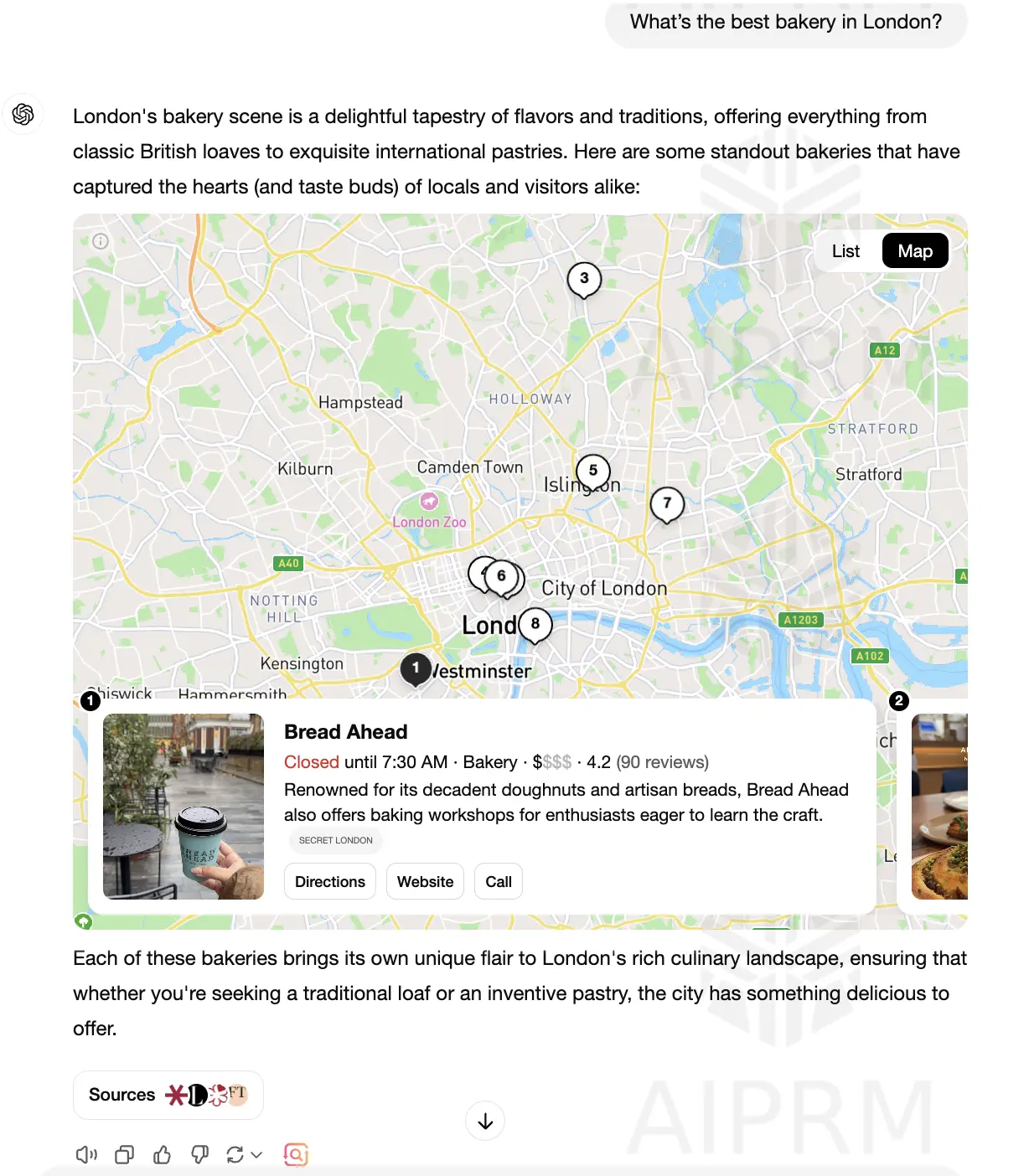
Example: A query like "What's the best bakery in London?" result in ChatGPT citing a bakery mentioned frequently in (sources) reviews, articles, or directories.
The Basics of Optimising for ChatGPT Search
Appearing in ChatGPT's sources starts with a strong foundation:
Accurate, up-to-date information: Ensure your website, blog, and directory profiles are regularly updated.
Focus on mentions: Prioritise getting your brand mentioned on high-quality platforms (e.g., local news sites or trade blogs).
If ChatGPT gives wrong info about your brand, report it to OpenAI.
Note: Let's say ChatGPT wrongly lists your restaurant as "closed." You can submit a correction via OpenAI's chat model feedback channels to fix the issue.
Adaptability is about the powerful difference between adapting to cope and adapting to win. – Max McKeown
Leveraging Local SEO for ChatGPT
Local SEO plays a critical role in ChatGPT's search responses. Here's how to optimise:
-
Update Your Google Business Profile (GBP):
Add accurate contact details, operating hours, and photos.
Encourage customers to leave Google reviews.
-
Consistency Across Directories:
Make sure your NAP (Name, Address, Phone) is the same everywhere.
-
Earn Positive Reviews:
Highlight your excellent customer service to encourage more reviews.
Respond promptly to both positive and negative feedback.
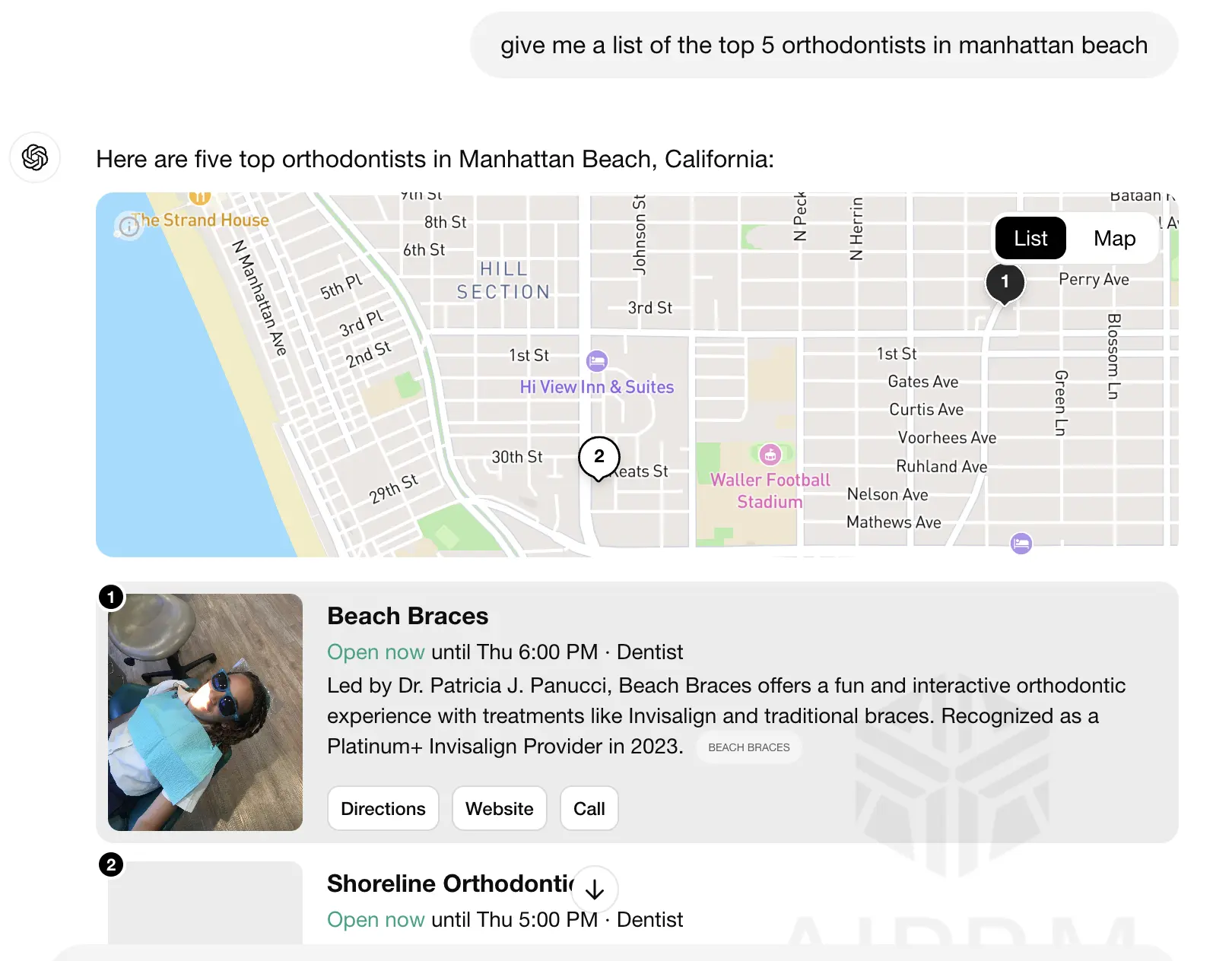
When asked, "Give me a list of the top 5 orthodontist in Manhattan Beach", ChatGPT prioritises highly-rated, consistent orthodontic businesses.
Note: in the example below, you can switch between 'List' and 'Map' via the button on the top right corner.
Building Authority Through Mentions
ChatGPT sources its information from mentions across the web, not just backlinks. Here's how to build authority:
Collaborate with Local Blogs and News Outlets: Pitch your story to local media or trade publications.
Host Events or Partner with Influencers: These partnerships often lead to mentions in articles or posts.
Write Guest Posts: Share your expertise on platforms relevant to your industry.
Example: A florist featured in a local "Top 10 Wedding Vendors" article is more likely to appear in ChatGPT's recommendations.
Keeping Up With LLM Updates
Large language models (LLMs) like ChatGPT are constantly evolving. Staying updated ensures your brand remains visible:
Monitor release notes: Check updates from OpenAI for changes to ChatGPT's training data.
Use tools like GPT for Sheets: Track how often your brand is mentioned in ChatGPT queries.
Example: After a recent update, ChatGPT introduces live browsing powered by Bing. Brands optimised for Bing's SEO see a spike in their visibility.
Optimising Content for Bing (ChatGPT's Search Engine)
Since Bing powers ChatGPT's live browsing, tailoring your content for Bing can boost your chances of appearing in ChatGPT's sources:
Focus on Keywords: Use location-based keywords like "best spa in Manchester."
Use Structured Data: Implement schema to help Bing understand your site's content.
Optimise for Voice Search: Many ChatGPT users rely on conversational queries.
Example: A local hotel optimised for the keyword "best 5-star hotel in Pattaya for privacy" appears in both Bing results and ChatGPT's sources.
Tracking and Measuring Success in ChatGPT Search
To know if your efforts are paying off:
Ask ChatGPT: Simply ask, "What do you know about [Your Brand]?"
Monitor Customer Feedback: Add "ChatGPT" as an option in your surveys to track referrals.
Analyse Metrics: Use tools like BrightLocal or Google Analytics to measure local search traffic.
Example: A cafe adds a "How did you hear about us?" form or survey to their website and discovers multiple customers found them via ChatGPT.
In Summary
ChatGPT Search is changing how brands connect with audiences. To boost your business's visibility, optimise for mentions, use local SEO, and stay updated. This will secure a spot in ChatGPT's sources.
Start applying these strategies today, and watch your brand become the go-to choice in its category!
About the Author
Perry Stevens is the founder of Blend Local Search Marketing, a Singapore-based agency specialising in local SEO, AI search optimisation, and online reputation management. With over 15 years in digital marketing, he helps businesses appear in AI-driven search results, Google rankings, and local directories. He's a tea drinker, cocoa grower, and frequent traveller. Connect with Perry on LinkedIn.
FAQ
How do I get my business on ChatGPT?
Getting your business on ChatGPT requires three steps: (1) Claim and optimise your Google Business Profile and Bing Places listing — ChatGPT pulls data from these directories. (2) Implement schema markup (LocalBusiness, Organization, FAQPage) on your website so AI can understand your services. (3) Build topical authority by publishing helpful, locally-focused content that answers common customer questions. Consistent NAP (Name, Address, Phone) across all platforms is critical.
How long does it take to get my business on ChatGPT?
Typically 4-8 weeks after implementing the steps above. ChatGPT's knowledge base updates periodically, so new businesses and recently optimised profiles may not appear immediately. The fastest way to accelerate this is to get listed in directories that ChatGPT sources from — particularly Google Business Profile, Yelp, Bing Places, and industry-specific directories. Businesses with strong online presence and recent positive reviews tend to appear faster.
How does ChatGPT choose its sources?
ChatGPT uses training data and live browsing (via Bing) to generate responses. Its answers are influenced by the quality, relevance, and frequency of mentions of a brand or topic across the web. So, brands with consistent, accurate info, strong online mentions, and good local SEO are more likely to be featured as sources.
Why doesn't ChatGPT always link directly to websites?
Unlike traditional search engines, ChatGPT prioritises summarising information rather than providing direct links. It often cites trusted sources or mentions a brand by name. This makes brand mentions and accurate online presence more important than just backlinks.
Can I check if my brand is mentioned in ChatGPT Search?
Yes! You can simply ask ChatGPT something like, "What do you know about [Your Brand]?" to see how it responds. Also, tools like GPT for Sheets or SpyGPT can track mentions and visibility in AI-generated responses.
What role does local SEO play in ChatGPT results?
Local SEO is crucial. ChatGPT often checks reviews and directories for local queries. Accurate, review-rich Google Business Profiles and local listings can boost your chances of appearing in ChatGPT's sources.
How can I report inaccuracies in ChatGPT about my business?
If ChatGPT gives wrong info about your business, report it via OpenAI's chat model feedback channels. This helps ensure the model has accurate data for future updates.
Is optimising for ChatGPT the same as traditional SEO?
While there's overlap, optimising for ChatGPT has unique aspects. Traditional SEO seeks high search engine rankings and traffic. ChatGPT, however, prioritises brand mentions, local reviews, and structured data. It's about building authority across platforms that AI models use as training sources.
How quickly can I appear in ChatGPT's sources?
It depends on your current online presence. If you already have a well-optimised website, consistent NAP, and positive reviews, you may already be mentioned. For new businesses, it typically takes 3-6 months of consistent effort: building citations, earning mentions, and maintaining accurate information. The key is consistency — regular updates, fresh content, and ongoing reputation management signal to AI models that your brand is active and trustworthy.
Want to appear in AI search results?
Book a free 30-minute AI Visibility Audit. We will review your current presence and recommend the right next step.
Book an AI Visibility Audit